
Stay Updated with CKIC Air Dome News

24K subscribers

Stay Ahead with CKIC Innovations! Subscribe to receive updates on new product launches, case studies, and breakthroughs in inflatable membrane technology.

Unlocking Energy Potential: CO2 Charge Technology

The CO2 charge technology, formally known as supercritical carbon dioxide (S-CO2) energy storage and power generation technology. It represents an innovative approach to both energy storage and conversion. This method capitalizes on the unique properties of carbon dioxide when in a supercritical state—above 31.1°C and 7.38 MPa. In this state, CO2 exhibits characteristics of both gas and liquid, enabling highly efficient energy conversion. This dual storage and release of electrical and thermal energy positions S-CO2 technology as a groundbreaking solution in the energy sector.

How the CO2 Charge Technology Works?

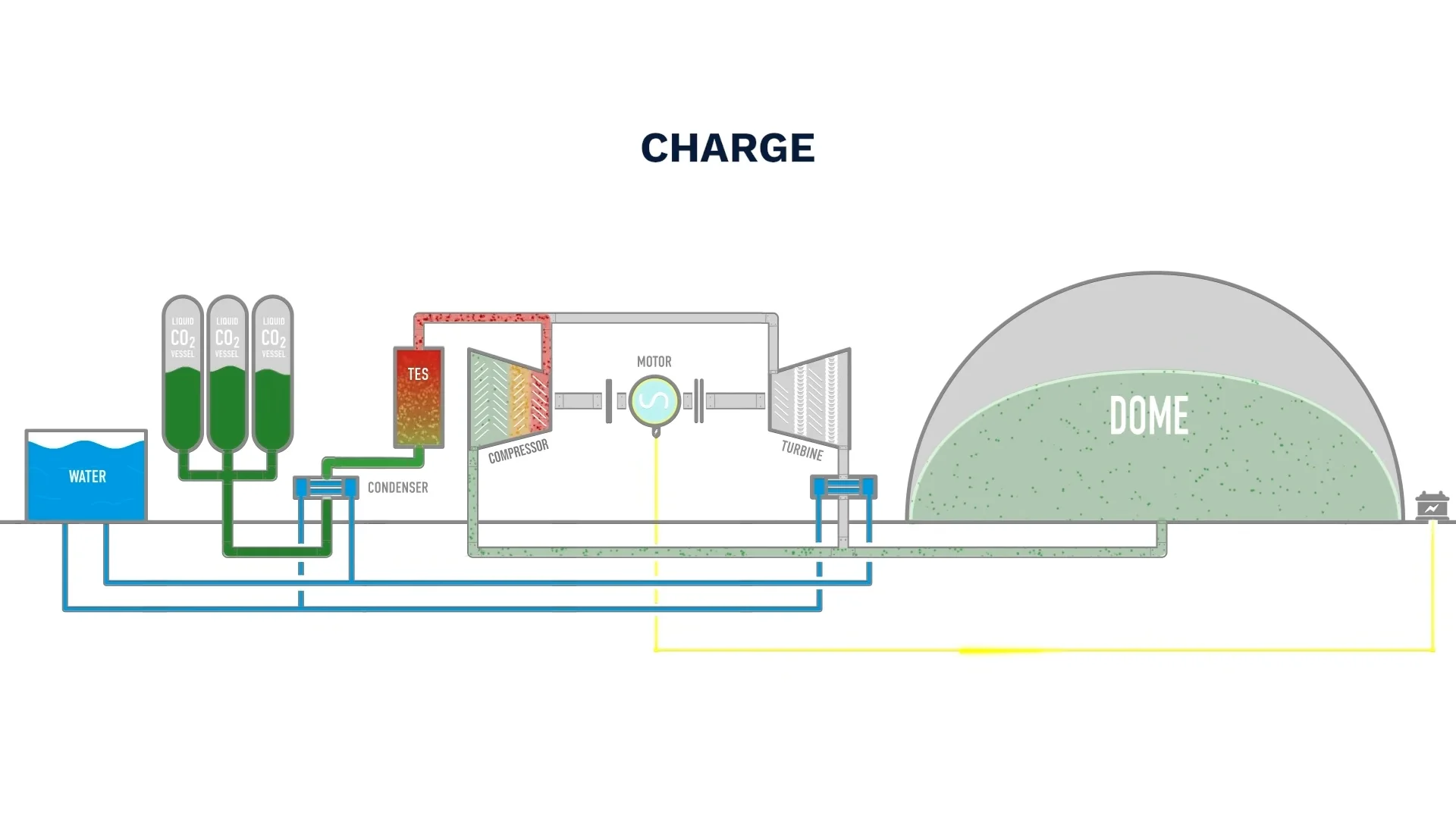
Energy Storage Phase (Charging)

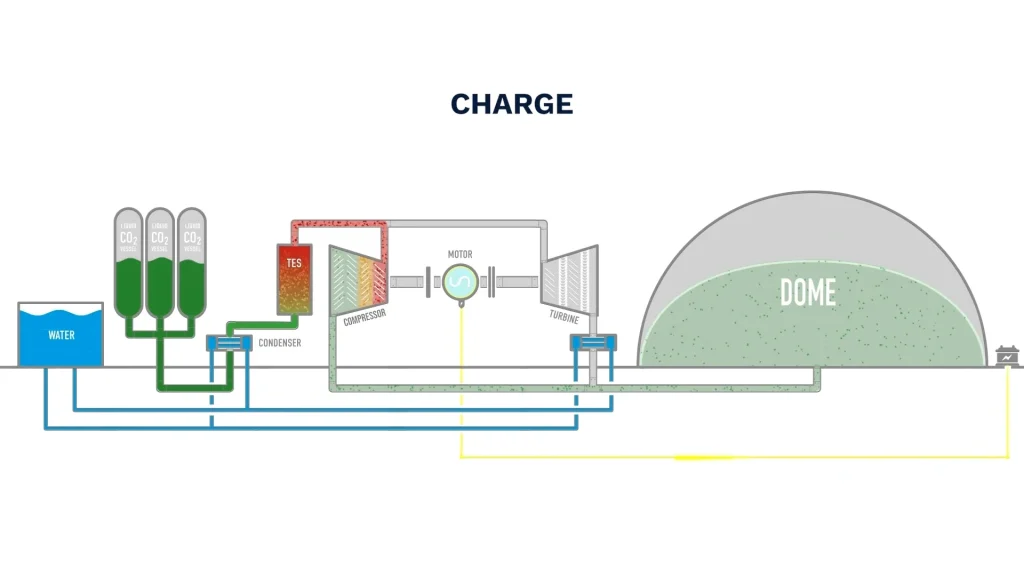
  1. Compression Storage: During off-peak periods or when renewable energy is abundant, CO2 gas is stored at ambient temperature. Also, pressure is compressed to a supercritical state. That is pressure > 7.39 MPa, temperature ≥ 31.1°C. The heat generated from this compression is stored in materials such as molten salts.
  2. Cooling and Storage: The supercritical CO2 is subsequently cooled to either a liquid state or as a high-pressure gas and stored in insulated storage tanks. This achieves dual storage of both pressure and thermal energy.

Energy Release Phase (Discharging)

  1. Heating and Expansion: The high-pressure liquid CO2 is released, heated, and absorbs stored thermal energy, converting into high-temperature, high-pressure gas.
  2. Turbine Generation: This high-pressure gas drives a turbine to generate electricity. The gas, after expansion, is cooled and returned to its initial state, ready for another cycle.

Core System Components

  • Closed Loop System: This includes compressors, turbines, heat exchangers (regenerators, preheaters), and thermal storage tanks (high and low temperature). The closed-loop design ensures minimal CO2 loss, maximizing efficiency.
  • Thermal Storage System: Utilizing materials like molten salts and solid ceramics, this system stores the waste heat generated during the compression process. In this way, it substantially improves energy utilization efficiency.

Core Advantages and Technical Features

Ultra-High Energy Conversion Efficiency

Traditional steam turbine systems operate at approximately 35% to 40% efficiency. In contrast, the S-CO2 Brayton cycle can achieve efficiencies of 45% to 55% when coupled with high-temperature heat sources above 700°C. This represents a 15% to 20% improvement over conventional systems, thanks to the low viscosity, high thermal conductivity, and high density of supercritical CO2, which reduce pipeline resistance and equipment size. Tests at the Sandia National Laboratories have shown that, under 650°C heat source conditions, the S-CO2 cycle is 12% more efficient than steam cycles, using 20% less thermal input for the same power output.

Environmentally Friendly and Low-Carbon Potential

  • Zero Emission Operation: The closed-loop system ensures that CO2 is recycled with no waste emissions. Using CO2 captured from industrial processes, such as those from coal-fired power plants. This further enhances carbon utilization and contributes to carbon neutrality goals.
  • Low Environmental Impact: Unlike pumped hydro storage, which requires extensive water resources, or lithium batteries that carry contamination risks, the S-CO2 technology occupies significantly less land (1/10th to 1/5th the size of steam systems) and uses non-toxic, non-flammable CO2 as a working medium, enhancing safety.

High Energy Density and Compact Design

The energy density of supercritical CO2 (approximately 0.5 to 1.0 kWh/L) is 5 to 10 times that of traditional compressed air energy storage (0.1 kWh/L). This results in a 60% to 70% reduction in equipment size. For instance, a storage system rated at 100 MWh requires about 500 square meters, compared to over 2000 square meters for an equivalent lithium battery system.

Versatile Integration Capability

The S-CO2 technology can interface with multiple heat sources, including photovoltaic and solar thermal systems, high-temperature gas-cooled reactors, industrial waste heat from steel and cement plants (300 – 700°C), and even retrofitting coal-fired plants for clean and efficient operation.

Rapid Response Time

The system can transition from a cold start to full power generation in just 10 to 15 minutes. It significantly outpaces coal-fired plants, which typically require over 30 minutes. This rapid response makes S-CO2 a prime candidate for grid frequency regulation and backup power applications.

Primary Application Scenarios

Grid-Scale Long-Duration Energy Storage and Load Shifting

When paired with renewable energy sources like photovoltaic systems, S-CO2 technology can provide continuous power for 10 to 16 hours. It effectively addresses the intermittent nature of wind and solar sources. For example, China planned a 50 MW supercritical CO2 solar thermal storage project in Gansu to achieve overnight continuous power generation, with expected storage costs 30% lower than lithium battery systems.

Industrial Waste Heat Recovery and Efficient Power Generation

Industries such as steel and cement generate substantial amounts of mid- to high-temperature waste heat (300 – 600°C) that traditional methods cannot efficiently utilize. S-CO2 systems can directly recover this waste heat for power generation, achieving efficiencies exceeding 15% compared to steam turbines. For instance, a steel plant in Shandong saw its waste heat power generation efficiency increase from 22% to 35%, resulting in an annual power output increase of 20 million kWh.

Next-Generation Nuclear Power and Clean Heating

The integration of S-CO2 systems with high-temperature gas-cooled reactors can yield efficiencies exceeding 50% (traditional nuclear plants operate around 33%). This configuration reduces equipment complexity and cost while repurposing waste heat for district heating—achieving combined heat and power generation.

Carbon Capture and Utilization Storage

Utilizing CO2 captured from coal-fired power plants as the working fluid creates a closed-loop system. And this facilitates power generation while minimizing carbon emissions, effectively driving the transition of traditional energy sources toward cleaner alternatives.

Current Development and Challenges

Global R&D Progress

In China, leading institutions like the Xi’an Thermal Engineering Research Institute and Tsinghua University have established multiple demonstration projects. For instance, the 1 MW supercritical CO2 storage demonstration unit in Xi’an is set to operate for 72 hours continuously with an efficiency of 48%.

Internationally, organizations like the Sandia National Laboratories and Germany’s DLR are conducting 20 MW pilot tests, with commercialization expected by 2030. Spain’s Abengoa is planning the first 50 MW “solar thermal + S-CO2 storage” project in Morocco.

Key Challenges

  • Material Temperature Resistance: In environments exceeding 700°C, the corrosiveness of CO2 can significantly challenge steel materials, necessitating the development of new nickel-based alloys or coatings, which can be costly.
  • System Integration Complexity: High-pressure components such as compressors and turbines require precise manufacturing tolerances (micrometer level) to ensure stable long-term operation.
  • High Initial Investment: Current costs for 100 MW projects are approximately 15 million RMB/MWh, which is 2 to 3 times that of lithium battery systems, necessitating economies of scale for cost reduction (with a projected 40% decrease by 2035).

The CO2 charge technology harnesses the efficient energy conversion capabilities of supercritical CO2, overcoming traditional thermal cycle efficiency barriers while delivering high power density, environmental friendliness, and multi-energy coupling advantages. As this technology progresses beyond the demonstration phase, it holds immense potential in long-duration energy storage, industrial energy efficiency, and carbon neutrality—key areas crucial for global energy transition.

About CKIC…

CKIC air dome team specializes in diverse and cost-effective inflatable dome solutions for various applications, like air domes for military, industrial, cultural and sports, recreational, and agricultural use, trusted by a wide range of industries.

If you’re exploring sustainable and cost-effective inflatable dome solutions for your projects, please feel free to get the free professional suggestions here. Let’s work together toward a greener future!

Leave a Reply

Your email address will not be published. Required fields are marked *